ICP Scoring Rubric for Logistics and Supply Chain Companies
Cale Parks

Fuse is the fractional growth platform built exclusively for logistics, freight tech, and supply chain companies. We combine a dedicated team of senior marketers, custom tooling, and a live revenue operating system to drive qualified pipeline — operating as a seamless extension of your team.
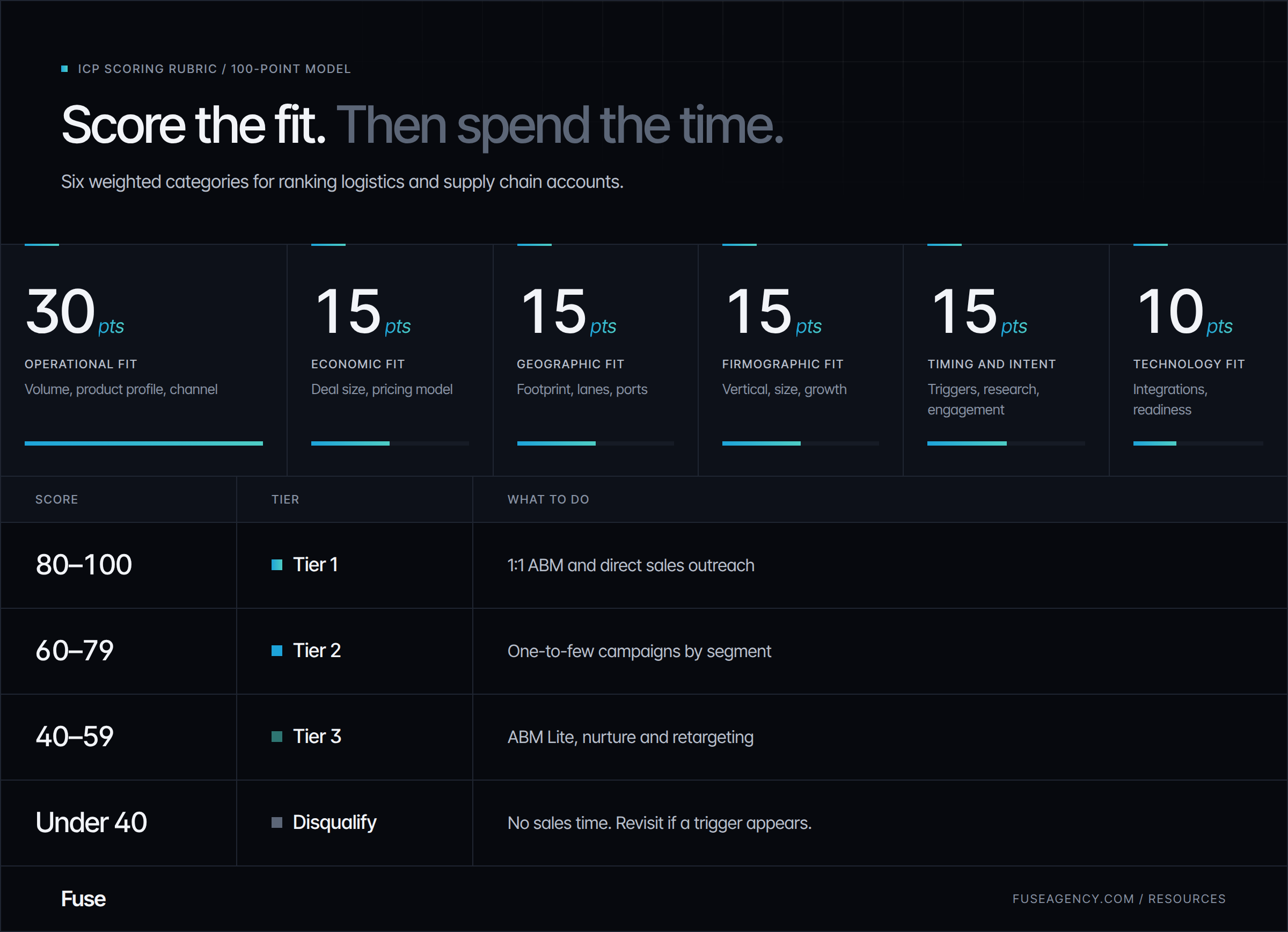
An ICP scoring rubric is a weighted point system that ranks accounts by how closely they match your ideal customer profile. For logistics and supply chain companies, a 100-point model works well: operational fit (30 points), economic fit (15), geographic fit (15), firmographic fit (15), timing and intent (15), and technology fit (10). Accounts scoring 80 or above are Tier 1 targets for direct sales and 1:1 ABM, and accounts under 40 should be disqualified.
An ICP scoring rubric turns a loose description of a good customer into a number your sales and marketing teams can act on. Logistics companies need this more than most, because fit depends on operational details like order volume, product profile, and location that generic B2B scoring models ignore.
If you run marketing, sales, or revenue operations for a 3PL, freight provider, or supply chain technology company, this guide gives you a rubric to copy, adjust, and load into your CRM this quarter.
What Is an ICP Scoring Rubric?
An ICP scoring rubric is the set of weighted criteria you use to score each account against your ideal customer profile (ICP). It sits alongside three related tools that teams often confuse:
- ICP: The type of company most likely to buy, succeed with you, and stay profitable.
- ICP scoring rubric: The criteria and weights that measure how closely a specific account matches the ICP.
- Lead score: A contact-level score based on engagement, such as email clicks, page views, or form fills. Lead scores measure interest. ICP scores measure fit.
- Buyer personas: Profiles of the people inside the account. See our guides to supply chain tech buyer personas and supply chain services buyer personas.
A high lead score on a poor-fit account wastes sales time. A strong ICP score tells reps where that time should go.
The 100-Point ICP Scoring Rubric for Logistics and Supply Chain
Score each account across six categories that add up to 100 points. Operational fit carries the most weight because in logistics, a customer who doesn't match your operation costs money even after they sign.
Operational Fit (30 points)
Operational fit measures how closely the account's volume and product profile match what you do well.
- Volume match (0 to 12): Order, pallet, or load volume falls in your profitable range. Score 12 for a direct match, 6 for close, 0 for far outside.
- Product profile (0 to 10): Temperature, hazmat, dimensions, SKU count, and handling needs match your capabilities.
- Channel or use-case fit (0 to 8): DTC, B2B retail, marketplace, or the specific workflow your software supports.
Economic Fit (15 points)
Economic fit measures whether the account can become a profitable customer at your prices.
- Deal size vs. minimums (0 to 8): Projected annual revenue clears your minimum and target deal size.
- Pricing model acceptance (0 to 4): The buyer is open to your structure, whether per order, per pallet, per load, or subscription.
- Budget signals (0 to 3): A known budget or an engaged executive sponsor.
Geographic Fit (15 points)
For services companies, geographic fit measures whether the account's customers, inventory, and lanes sit inside your footprint. For software companies, it measures whether you support their regions and deployment needs.
- Service area coverage (0 to 10): Most of the account's customers or lanes fall within your network.
- Infrastructure proximity (0 to 5): Access to the ports, rail, or facilities that matter for this account.
Firmographic Fit (15 points)
- Industry vertical (0 to 6): A vertical where you have case studies and references.
- Company size or revenue band (0 to 5): Inside the range of your best current customers.
- Growth signals (0 to 4): Hiring, funding, new locations, or new product lines.
Timing and Intent (15 points)
- Trigger event (0 to 7): A service failure, new sales channel, contract renewal, new DC, ERP migration, or leadership change.
- Intent signals (0 to 5): Research activity on topics you sell, review site visits, or competitor comparisons.
- Engagement (0 to 3): Visits to pricing or contact pages, event attendance, or replies to outreach.
Technology Fit (10 points)
- Integration compatibility (0 to 6): Their WMS, ERP, ecommerce platform, or EDI setup works with yours.
- Implementation readiness (0 to 4): Clean data, available IT resources, and the internal capacity to onboard.
How Should Services and Tech Companies Weight the Rubric?
Start with the default model above, then shift weight toward the traits that best predict success in your business. These starting weights work for the three most common logistics business models:
- 3PL and warehousing: Operational 30, Geographic 20, Economic 15, Timing and intent 15, Firmographic 10, Technology 10. Location matters more because inventory has to sit close to customers.
- Freight and transportation: Operational 35 (lanes, shipment frequency, modes), Timing and intent 20, Geographic 15, Economic 15, Firmographic 10, Technology 5. Timing carries extra weight because freight needs shift quickly.
- Supply chain software: Operational 25, Technology 20, Firmographic 15, Economic 15, Timing and intent 15, Geographic 10. Integration fit decides implementation success, while software sells across regions.
Specialized operators should go one level deeper. A cold storage provider might give product profile 15 of the 30 operational points, since certifications and temperature ranges disqualify more accounts than volume does. An automation vendor might add facility size and automation readiness to operational fit.
How Do You Use ICP Score Tiers?
Tiers turn scores into action by telling sales and marketing how much effort each account deserves. Use these thresholds as a starting point:
- Tier 1 (80 to 100): Named accounts for direct sales outreach and 1:1 account-based marketing. Keep the list short; most 1:1 programs work best with 5 to 20 accounts.
- Tier 2 (60 to 79): One-to-few campaigns grouped by vertical, use case, or company size.
- Tier 3 (40 to 59): ABM Lite, nurture sequences, and retargeting until a trigger event moves them up.
- Disqualify (under 40): Don't spend sales time here. Revisit only if a major trigger appears.
These tiers map directly to the program levels in our guide to account-based marketing for supply chain companies.
Worked Example: Scoring a 3PL Prospect
Here is how a Midwest 3PL might score a supplement brand shipping 18,000 DTC orders a month plus wholesale orders to two regional retailers:
- Operational fit, 26 of 30: Volume in range (12), ambient product with lot tracking (9), DTC plus retail channel mix (5).
- Economic fit, 11 of 15: Clears the monthly minimum (8), open to per-order pricing (3), no confirmed budget yet (0).
- Geographic fit, 12 of 15: Most customers within two-day ground (8), good highway access to retail DCs (4).
- Firmographic fit, 12 of 15: Supplements vertical with existing case studies (6), revenue band matches top customers (4), moderate growth signals (2).
- Timing and intent, 13 of 15: Retail chargebacks last quarter (7), researching 3PL pricing (4), visited the pricing page (2).
- Technology fit, 8 of 10: Shopify and NetSuite already supported (6), SKU data needs some cleanup (2).
- Total, 82 of 100: Tier 1. Route to a named rep with a chargeback-reduction case study.
How to Build and Validate Your ICP Scoring Rubric
The best rubric is built from your own customer data and tested against past results before anyone uses it. Follow these six steps:
- Pull 12 to 24 months of account data. Include closed-won, closed-lost, and churned accounts.
- Compare your best customers to your worst. Look at margin, tenure, and cost to serve. The traits that separate them become your criteria.
- Assign weights. Give more points to traits that most strongly predict a profitable, long-term customer.
- Back-test. Score last year's accounts and confirm your best customers land in Tier 1 and Tier 2.
- Load it into your CRM. HubSpot and Salesforce both support custom scoring properties, so reps see the score on every account record.
- Review quarterly with sales. Adjust weights when win rates by tier start to drift.
What Are the Most Common ICP Scoring Mistakes?
Most ICP scoring problems come from measuring the easy things instead of the predictive ones. Watch for these five:
- Scoring on company size alone: A large company with the wrong product profile is still a poor fit.
- Ignoring profitability: Score against margin and cost to serve, not just closed deals.
- Treating intent as fit: A high-intent account outside your footprint still loses money.
- Setting it and forgetting it: Markets change. Re-score accounts at least twice a year.
- Too many criteria: More than 15 to 20 criteria slows scoring, and few teams keep it up to date.
ICP Scoring Rubric FAQs
What should an ICP scoring model include?
An ICP scoring model should include firmographic, operational, geographic, economic, technology, and timing criteria, each with a weight. For logistics companies, operational fit, meaning volume, product profile, and channel mix, should carry the most weight because it determines whether an account is profitable to serve.
What is a good ICP score?
In a 100-point model, 80 or above signals a Tier 1 account, 60 to 79 is Tier 2, 40 to 59 belongs in nurture, and under 40 should be disqualified. Calibrate these thresholds by back-testing the rubric against your past wins and losses.
What is the difference between ICP scoring and lead scoring?
ICP scoring measures how well an account fits your ideal customer profile. Lead scoring measures how engaged a specific contact is. Use them together: prioritize high-fit accounts, then use engagement to time your outreach.
How often should you update an ICP scoring rubric?
Review the rubric quarterly and rebuild it once a year. Update it sooner if you open a new facility, launch a new service or product, or enter a new vertical.
Conclusion
An ICP scoring rubric gives logistics and supply chain companies a shared, numeric answer to the question of which accounts deserve sales time. Weight operational fit highest, adjust the model for your business type, and back-test it against real results before rolling it out. Want a rubric built from your own CRM data? Schedule a strategy call with Fuse.