
A Step-by-Step Guide to Developing a 3PL Warehouse Ideal Customer Profile (ICP)
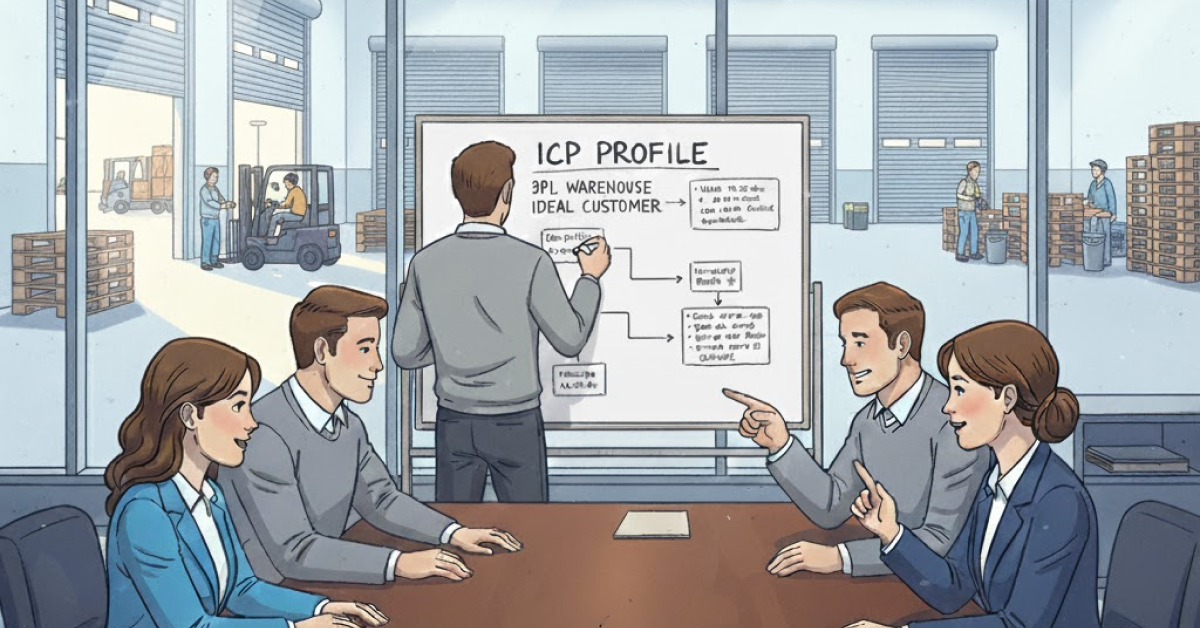
From Spray and Pray to Precision: A Step-by-Step Guide to Developing a 3PL Warehouse Ideal Customer Profile (ICP)
In the quest for business growth, many 3pl warehouses cast a wide net, hoping to catch as many leads and customers as possible. The result is often scattered marketing, a drained budget, race to bottom pricing, and low win rates. The problem isn't a lack of effort; it's a lack of focus. The solution is to stop marketing to everyone and start focusing on your best potential customers. This is where the Ideal Customer Profile (ICP) becomes your North Star for sustainable growth.
An ICP is a detailed, semi-fictional description of the perfect company to target—not a person, but an organization that gains the most value from your product or service and, in turn, provides the most value to you.
ICP vs. Buyer Persona: What's the Difference?
This is a common point of confusion. Think of it this way:
- Ideal Customer Profile (ICP): Describes the company. It focuses on firmographics like industry, company size, budget, and technological infrastructure. It answers the question, "What is the perfect company to sell to?"
- Buyer Persona: Describes the people within that company who are involved in the buying decision. It focuses on their job titles, responsibilities, pain points, and motivations. It answers the question, "Who do we need to convince at this company?"
You need both. The ICP identifies the right forest, and the Buyer Personas help you navigate to the right trees within it.
Why Your Business Needs an ICP
Defining your ICP is a foundational exercise that provides immense clarity. The benefits include:
- Hyper-Focused Marketing: You know exactly which companies to target, what messages will resonate, and which channels to use, maximizing your return on investment.
- Increased Sales Efficiency: Your sales team stops wasting time on poor-fit leads and can focus on prospects who are much more likely to convert, shortening sales cycles.
- Improved Product Development: Understanding your ideal customer's deepest needs allows you to build a product roadmap that solves real problems, delighting users.
- Higher Customer Retention: Customers who are a perfect fit for your solution will experience more success, be happier, and remain loyal longer. This leads to a higher Customer Lifetime Value (LTV).
- Company-Wide Alignment: When sales, marketing, product, and customer success are all aligned around the same ICP, the entire organization moves in a unified, efficient direction.
A Step-by-Step Guide to Developing Your ICP
Creating an ICP is a data-driven process, not a brainstorming session. Follow these steps.
Step 1: Analyze Your Best Customers
Your happiest existing customers are the blueprint for your future customers. Look through your customer list and identify the top 5-10 organizations that represent a "win." Don't just go by revenue; look for a combination of factors:
- High Customer Satisfaction: They have high Net Promoter Scores (NPS) or provide positive feedback.
- High Profitability: They have a strong Lifetime Value to Customer Acquisition Cost ratio (LTV>CAC).
- Successful Use Case: They are using your product to its full potential and seeing tangible results.
- Low Churn Risk: They are loyal and have renewed their contracts.
- Brand Advocates: They are willing to provide testimonials, case studies, or referrals.
Step 2: Identify Common Attributes
Once you have your list of best customers, it's time to play detective. Dig into the data and identify the common threads that connect them. Look for patterns across these categories:
- Firmographics: Industry/Vertical, geographical location, company size (both in employees and annual revenue).
- Technographics: What other software, technology, or tools do they use? Is your product an integration for a specific platform (e.g., Salesforce, HubSpot, AWS)?
- Behavioral Data: What pain points drove them to seek a solution? What specific event or "trigger" prompted them to buy?
- Operational Details: Do they have a specific team structure? What is their budget for a solution like yours?
Step 3: Conduct Customer Interviews
Quantitative data tells you the "what," but qualitative interviews tell you the "why." Reach out to your best customers from Step 1 and ask for a brief 20-minute conversation. The goal is to understand their story.
Ask open-ended questions like:
- "Can you describe the challenges you were facing right before you started looking for a solution?"
- "What did the buying process look like for your team?"
- "What were the most important criteria for you when evaluating options?"
- "What specific results or value have you seen since implementing our product?"
- "What would have happened if you had not found a solution?"
Step 4: Synthesize and Draft Your ICP
Now, consolidate all your findings into a single, shareable document. This document will serve as your organization's source of truth.
Ideal Customer Profile (ICP) Template
Here is a comprehensive template you can adapt for your business.
Profile Name: [Give your ICP a descriptive name, e.g., "Mid-Market Supplements or Nutraceutical brands" or "Medical device shippers importing 50+ TEUs/year"]
1. Summary Narrative
- [Write a 2-3 sentence paragraph that paints a clear picture of this company. What is their core mission and what makes them an ideal fit for you?]
2. Firmographics (Company-Level Data)
- Industry/Vertical: [e.g., Supplements, Food and Beverage, Medical Devices, Pulp and Paper]
- Company Size (Employees): [e.g., 50-200 employees]
- Company Size (Annual Revenue): [e.g., $10M - $50M ARR]
- Geography: [e.g., North America, EMEA, specific states or countries]
- Budget: [Estimated budget for your type of solution, e.g., $25k - $75k annually]
3. Behavioral & Operational Attributes
- Primary Pain Points: [List 3-5 key problems they face that your warehouse solves. e.g., "retail compliance penalties," "inventory accuracy," "omnichannel fulfillment"]
- Business Goals & Objectives: [What are they trying to achieve? e.g., "expanding into a new market" "Reduce operational costs," "launching a new sales channel"]
- Buying Triggers: [What events cause them to seek a solution? e.g., "Just added a new customer in this market" "re-evaluating our existing 3PL" "Launched a new product"]
- How They Measure Success: [What KPIs matter most to them? e.g., "order accuracy" "on-time shipping" "dock-to-stock SLA"]
4. Red Flags (Characteristics of a Poor Fit)
- [List attributes that signal a company is NOT a good fit. This is crucial for disqualifying leads quickly.]
- Example 1: [Company size under 20 employees (too small to get value).]
- Example 2: [Lacks a dedicated sales team.]
- Example 3: [Operates in a highly regulated industry we don't support.]
Putting Your ICP into Action
An ICP document is useless if it just sits in a folder. It must be actively used across the organization:
- Marketing: Uses the ICP to create targeted content, define ad audiences, and select the right promotional channels.
- Sales: Uses the ICP as a checklist to qualify leads, ensuring they only spend time on high-potential prospects.
- Product: Uses the ICP's pain points and goals to prioritize features on the product roadmap.
- Customer Success: Uses the ICP to understand the definition of "success" for new customers, ensuring a smooth onboarding process.
An Evolving Document
Your business will change, the market will shift, and your product will evolve. Your ICP is not set in stone. Plan to review and refine it at least once a year, or whenever you notice a significant change in your business, to ensure it remains an accurate and powerful tool for growth.
About Fuse
Fuse is a boutique marketing agency solely focused on the logistics and supply chain sector. Through industry expertise, deep B2B marketing knowledge, and our purpose-built team, we help supply chain companies build sales and marketing programs that drive business results.


